
Feelings Magnets for Healing: A Trauma-Informed Guide

Most of us were never taught to name what we feel beyond “good,” “bad,” or “fine.” Feelings magnets change that. They give you a physical, visual way to reach into the fog of overwhelming emotion and pull out something specific, something you can actually work with. If you’ve spent years numbing out, spiraling in anxiety, or struggling to explain why you feel the way you do, this tool isn’t just a cute classroom prop. It’s a doorway into a kind of emotional clarity that can genuinely shift how you heal.
Table of Contents
- Key takeaways
- What feelings magnets actually do to your brain
- Types of feelings magnets and what to look for
- How to use feelings magnets for emotional regulation
- Limitations worth knowing before you start
- My honest take on feelings magnets and healing
- Keep going: resources for your healing path
- FAQ
Key takeaways
| Point | Details |
|---|---|
| Feelings magnets expand emotional vocabulary | Naming emotions with precision reduces reactivity and supports better mental health outcomes. |
| Brain science backs this practice | The hippocampus and vmPFC map emotions by valence and arousal, and visual tools help expand that map. |
| Multiple formats exist | From word sets to visual boards to strategy kits, options range from affordable single packs to full bundles. |
| Pairing labeling with action matters | Naming a feeling works best when followed by a coping strategy, not left as a standalone practice. |
| Not one size fits all | For some conditions like panic disorder or addiction recovery, affect labeling requires careful, guided use. |
What feelings magnets actually do to your brain
Your brain doesn’t store emotions in one tidy drawer. Research shows that the hippocampus and vmPFC organize emotions along two axes: valence (pleasant vs. unpleasant) and arousal (calm vs. activated). Think of it as an internal emotional map, a kind of geography your nervous system navigates every day.
Here’s what’s striking. When someone lives with depression, chronic anxiety, or unprocessed trauma, that emotional map gets compressed. Everything collapses into a few blurry categories. You feel “bad” or “overwhelmed” or “numb,” and your brain genuinely cannot access more specific terrain. This isn’t a character flaw. It’s a neurological pattern.
This is where emotional granularity comes in. Emotional granularity is your ability to distinguish between feelings that seem similar but are actually very different. “Anxious” and “ashamed” feel awful in overlapping ways, but they call for completely different responses. When you can tell them apart, you can respond more wisely. Studies confirm that affect labeling reduces emotional reactivity by measurably lowering amygdala activation and physiological stress signals.
Feelings magnets work as a physical prompt for this process. When you reach for a word on a board, you’re not just picking a label. You’re actively expanding your emotional map, one moment at a time.
Pro Tip: Place your feelings magnet board somewhere you pass daily, like the bathroom mirror or the fridge. The more your eyes land on specific emotion words, the more your brain begins to build pathways to them, even before a crisis hits.
Here’s what the research highlights about emotional granularity and brain health:
- People with richer emotional vocabularies report lower levels of anxiety and depression over time.
- Emotional mapping tools help differentiate nuanced feelings, which directly supports regulation and well-being.
- Affect labeling works through a systematic process confirmed across 32 separate studies, though its effectiveness varies by individual and context.
- Trauma survivors often have the most compressed emotional maps, making this kind of vocabulary work especially meaningful for their healing.
Types of feelings magnets and what to look for
Not all feelings magnets are the same, and the differences matter more than you might expect. The right format for a grieving adult in recovery looks very different from what works for a child learning to identify frustration.
Here’s a breakdown of the main types available:
- Word-based magnet sets: Collections of emotion words on individual magnets. Great for adults who want to build vocabulary and create personal arrangements on a fridge or whiteboard.
- Emotion wheel magnets: Circular visual charts that show how emotions relate to each other. These help you move from a broad feeling like “upset” toward something more specific like “betrayed” or “disappointed.”
- Feelings thermometer magnets: These show emotional intensity on a scale. The Feelings Thermometer magnets distributed through the Wisconsin Department of Administration sell for $23.40 per pack of 24, making them one of the most affordable standardized options available.
- Magnetic strategy boards: These combine emotion identification with coping tools. You name the feeling and then select a response. Visual strategy boards are especially powerful during high distress because they allow non-verbal selection of coping steps when words feel impossible.
- Full emotion regulation bundles: These include boards, clings, and strategy cards together. Emotion regulation bundles typically range from $50 to $65 and offer the most complete experience.
Here’s a quick comparison to help you choose:
| Type | Best for | Price range | Key feature |
|---|---|---|---|
| Word magnet sets | Adults building vocabulary | $10 to $25 | Flexible, customizable |
| Feelings thermometer | Kids and adults tracking intensity | Around $23 | Standardized, affordable |
| Emotion wheel magnets | Visual learners | $15 to $30 | Shows emotional relationships |
| Strategy boards | High-reactivity moments | $30 to $50 | Combines labeling with coping |
| Full bundles | Ongoing daily practice | $50 to $65 | Most complete toolkit |
One practical note worth knowing: static-cling markers on visual boards are often more effective than traditional adhesive magnets for frequent daily use. They update easily, leave no residue, and hold up well in high-traffic spots like kitchens or therapy rooms.

How to use feelings magnets for emotional regulation
Having a set of feelings magnets sitting in a drawer does nothing. The practice is in the using. Here’s how to build it into your actual life.
- Set up your board at eye level. Placement matters. Eye-level positioning means you engage with the board naturally rather than having to seek it out. A fridge, a bathroom mirror, or a wall near your desk all work well. The goal is low friction access when emotions are running high.
- Use it during, not just after, a hard moment. Most people journal about feelings after the storm passes. Feelings magnets are designed for the middle of it. When you feel your chest tighten or your thoughts start to spiral, walk to the board and scan the words. You’re looking for the one that makes your body say yes, that’s it.
- Pair the label with one coping step. Naming the feeling is the start, not the finish. Once you’ve identified “humiliated” or “terrified” or “lonely,” ask yourself what that feeling needs. Deep breathing, movement, calling someone, writing it down. The pairing of labeling with explicit strategies is what makes affect labeling genuinely useful rather than just self-aware.
- Use it for storytelling and reflection. At the end of the day, you can use your magnets to map out the emotional arc of what you experienced. This kind of reflective practice builds emotional intelligence over time and helps you spot patterns in your triggers and responses.
- Personalize it. Add words that matter to your specific story. If “triggered” or “dissociated” or “raw” are part of your emotional vocabulary, write them on blank magnets. Your healing is yours. The tool should reflect that.
Pro Tip: If you’re in addiction recovery, use your feelings board during cravings. Cravings are often emotions in disguise. Naming the underlying feeling, whether it’s loneliness, boredom, or shame, can interrupt the automatic reach for a substance and create a moment of choice.
The heart’s electromagnetic field is the strongest magnetic signal in the body and is closely tied to emotional states. There’s something quietly powerful about using a physical, magnetic object to anchor emotional awareness. It connects the body and the mind in a way that purely mental practices sometimes miss.
Limitations worth knowing before you start
Feelings magnets are a meaningful tool. They are not a cure. And for some people in some moments, they can actually make things harder before they make them better.
Here’s what to hold with care:
- Affect labeling is not universal. A systematic review of 32 studies confirms that while labeling generally reduces reactivity, it doesn’t work the same way for everyone. Some people, especially those with high baseline anxiety, find that naming a feeling intensifies focus on it rather than diffusing it.
- Panic disorder requires extra caution. If you experience panic attacks, closely attending to internal emotional states can sometimes trigger or escalate symptoms. In these cases, affect labeling alone may increase distress and should be paired carefully with grounding techniques.
- Addiction recovery is nuanced. For those navigating substance use, sitting with raw emotions can feel destabilizing. This doesn’t mean avoid the practice. It means go slowly, ideally with a counselor or sponsor who understands what you’re working through.
- Feelings magnets complement therapy; they don’t replace it. If you’re processing significant trauma, a feelings board is a beautiful supplement to professional support. It is not a substitute for it.
- Avoid over-focusing on distressing feelings. There’s a difference between acknowledging an emotion and ruminating in it. If you find yourself repeatedly selecting the same painful word without moving toward any coping action, that’s a signal to shift the practice or seek support.
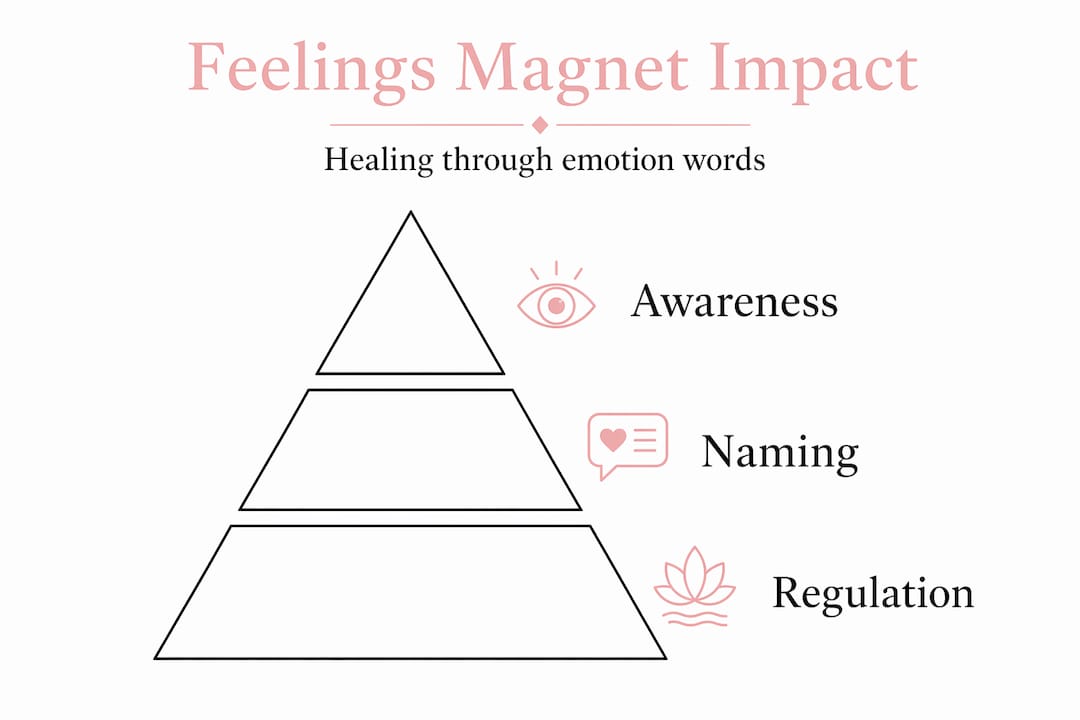
The goal is awareness that leads somewhere. Feeling the feeling, naming it, and then choosing what to do next. That sequence is where the healing lives.
My honest take on feelings magnets and healing
I’ve thought a lot about why feelings magnets moved me the way they did when I first encountered them. I’d spent years either drowning in emotion or completely disconnected from it. There was no middle ground. No nuance. Just flood or drought.
What I’ve learned is that having a visual vocabulary changes something fundamental. When I could see the word “grief-stricken” sitting next to “disappointed” and “heartbroken,” I realized those weren’t the same thing. I had been calling everything grief when some of it was actually shame, and some of it was fear, and some of it was just exhaustion.
That distinction mattered. Because grief and shame don’t heal the same way.
What I’d caution, though, is this: don’t use the board as a way to perform emotional awareness without actually doing anything with what you find. I’ve done that. Naming the feeling and then staying stuck in it, using the label as a destination rather than a starting point. The tool only works when you let it point you somewhere.
Be gentle with yourself as you learn this. You’re not behind. You’re just beginning to read a language your nervous system has been speaking all along.
— Christine Ballard
Keep going: resources for your healing path
If this resonated with you, you’re already doing the work. Recognizing that your emotions have names, that they can be mapped and understood rather than just survived, is one of the most quietly radical things you can do for yourself.

At Blogsppot, we write for women who are rebuilding. Women who have been through the fire and are still figuring out who they are on the other side. If you’re looking for more reflective tools, personal stories, and honest guidance on emotional healing, you’ll find a whole community waiting for you at Beautiful Detours by Christine. Come as you are. Stay as long as you need. The path forward doesn’t have to be walked alone, and every detour you’ve taken has brought you exactly here.
FAQ
What are feelings magnets used for?
Feelings magnets are visual tools that help people identify and name their emotions with greater precision. They support emotional regulation by expanding emotional vocabulary and reducing reactivity during difficult moments.
Do feelings magnets work for adults or just kids?
Feelings magnets work for both adults and children. Adults navigating trauma, anxiety, or addiction recovery often find them especially useful for building emotional granularity and pairing emotion awareness with coping strategies.
How much do feelings magnets cost?
Prices vary by type. Standardized sets like the Feelings Thermometer magnets run around $23.40 for 24 magnets, while full emotion regulation bundles typically range from $50 to $65.
Can feelings magnets help with trauma recovery?
Yes, when used thoughtfully. Feelings magnets help trauma survivors rebuild a compressed emotional map by offering specific vocabulary for experiences that often feel shapeless. Pairing them with professional support gives the best results.
Are there any risks to using feelings magnets?
For most people, no. However, those with panic disorder or active substance use challenges should use affect labeling carefully, as labeling alone can increase distress in certain high-reactivity states without a paired coping strategy.