
My life was a lie: a healing guide for reclaiming truth

There is a particular kind of vertigo that comes with the realization that my life was a lie. Not a small lie. Not a white lie. But the foundational kind, where the ground you built everything on turns out to have been hollow the whole time. If you are sitting with that feeling right now, whether it arrived through discovering betrayal, recognizing abuse, or finally naming what gaslighting did to your sense of self, I want you to know this: the disorientation you feel is not weakness. It is the first honest breath you have taken in a long time. And this guide is here to walk with you through what comes next.
Table of Contents
- Understanding trauma and the impact of deception
- How gaslighting rewires your nervous system and self-trust
- The shadow of self-deception: uncovering internalized lies and false identities
- Therapeutic tools and programs that foster healing and empowerment
- Applying narrative therapy and inner storytelling to reclaim your truth
- Why rebuilding trust in your own reality is the most radical act of healing
- Discover supportive paths to healing and empowerment
- Frequently asked questions
Key Takeaways
| Point | Details |
|---|---|
| Trauma distorts perception | Experiencing trauma and gaslighting can rewire your nervous system, causing confusion and eroding trust in your own reality. |
| Self-trust can be rebuilt | Techniques like perception journaling and body awareness enhance your ability to trust your inner knowing again. |
| Inner work heals self-deception | Confronting and integrating shadow parts helps release internal lies, paving the way to authenticity and growth. |
| Therapy guides recovery | Evidence-based therapies and holistic trauma programs provide tools and support for safety, coping, and empowerment. |
| Narrative shapes healing | Rewriting your story through narrative therapy fosters agency and resilience beyond the trauma experience. |
Understanding trauma and the impact of deception
When you discover that your life was built on deception, the emotional shock is not just about the betrayal itself. It is about every memory you now have to reexamine. Every moment you trusted, every choice you made, every version of yourself you believed in. That kind of ground-level disruption is trauma. Full stop.
Trauma, especially the kind born from sustained deception or abuse, reshapes how you perceive safety, yourself, and the world around you. It does not just leave emotional scars. It changes the lens through which you see everything. Negative trauma appraisals, meaning the internal stories you tell yourself about the threat you faced and your role in it, are central to how PTSD develops and persists. Research confirms that PTSD symptoms and self-blame decrease significantly in the first two months post-trauma with the right support. That is genuinely hopeful news.
What this means for you is that the fog you are living in right now is not permanent. It is a trauma response. And trauma responses can shift.
“The wound is the place where the light enters you.” The realization that the lie I lived was never your fault is the beginning of everything.
Here is what living a deception does to a person over time:
- It erodes your ability to trust your own perceptions and memories
- It creates a chronic low-level state of threat, even in safe situations
- It teaches your nervous system to scan for danger constantly
- It plants seeds of self-blame that feel like personal truth
- It disconnects you from your own instincts and inner knowing
Understanding this is not about excusing what was done to you. It is about dissolving the shame that has been quietly whispering that you should have known better.
How gaslighting rewires your nervous system and self-trust
Gaslighting is a specific and insidious form of deception. It does not just lie to you. It makes you doubt your own ability to perceive reality. Over time, your nervous system learns to default to doubt. Your gut says one thing, and your conditioned mind says, “You’re probably wrong.” That internal war is exhausting. And it is not accidental.

According to therapist Annie Wright, LMFT, gaslighting erodes self-trust by rewiring the nervous system to default to doubt, and recovery requires stage-specific interventions, including EMDR. This is not a character flaw you developed. It is a survival adaptation your brain made to keep you safe in an unsafe environment.
Rebuilding self-trust after gaslighting is not a single event. It is a practice. Here are four concrete steps to begin:
- Start a perception journal. Immediately after any interaction that leaves you feeling confused or “crazy,” write down exactly what happened, what was said, and what you felt. Facts first. No editing.
- Check in with your body. Chest tightness, stomach dropping, shoulders creeping toward your ears. These are data points, not overreactions. Your body often knows the truth before your mind catches up.
- Build a reality-testing circle. Find one or two people you genuinely trust and allow them to reflect your experiences back to you. This is called social scaffolding, and it is powerful.
- Name the doubt without obeying it. When the voice says “you’re imagining things,” practice saying, “That’s the gaslighting talking.” You do not have to silence it immediately. Just stop letting it make your decisions.
Pro Tip: Epistemic courage is the practice of trusting your own mind even when you have been trained not to. It is a skill, not a personality trait. You can build it, slowly and deliberately, one honest observation at a time.
The shadow of self-deception: uncovering internalized lies and false identities
Here is the part that takes real courage to look at. When we spend years living a deception, we do not just absorb external lies. We begin to internalize them. We build false identities around them. A persona that is agreeable enough, small enough, quiet enough to survive. And after a while, we forget that persona was ever a costume.
Self-deception rooted in family trauma blocks authentic growth but can be transformed through inner work that examines the shadow parts of yourself. In Jungian terms, the shadow is everything you have pushed into the dark because it felt too dangerous, too much, or too unacceptable to own.
The false front you built was never weakness. It was wisdom for a season. But you are in a new season now.
Recognizing your internalized lies looks like noticing these patterns:
- Automatically minimizing your own needs in relationships
- Feeling guilty when you express a boundary or preference
- Believing that your worth is conditional on your performance or compliance
- Dismissing your own successes while magnifying your perceived failures
- Feeling like the “real you” is somehow too much or not enough
These are not personality traits. They are survival strategies that outlived their usefulness. The work of discovering your reality is not about tearing yourself apart. It is about gently picking up the pieces of yourself that were set down in order to survive, and deciding which ones you actually want to carry forward.
Therapeutic tools and programs that foster healing and empowerment
Knowing that healing is possible and knowing how to heal are two different things. Let’s talk about the actual tools.
Trauma-focused therapies like TF-CBT, EMDR, and somatic experiencing typically span 8 to 12 weeks and provide skills for coping and stabilization. Each approach works differently, and the right fit depends on your history and nervous system.
| Therapy type | What it targets | Typical duration |
|---|---|---|
| TF-CBT (Trauma-Focused Cognitive Behavioral Therapy) | Thought patterns, self-blame, trauma narrative | 8 to 16 sessions |
| EMDR (Eye Movement Desensitization and Reprocessing) | Stored traumatic memories and nervous system response | 6 to 12 sessions |
| Somatic experiencing | Body-held trauma, physical stress responses | Ongoing, body-paced |
| Narrative therapy | Identity, story reframing, self-authorship | Varies by need |
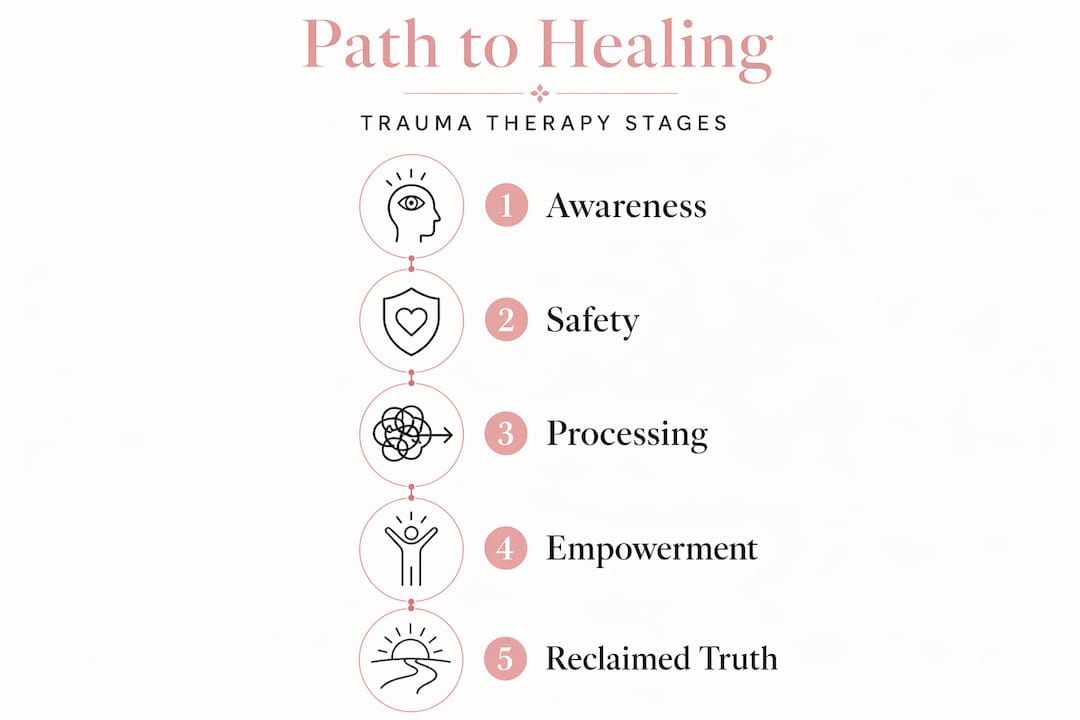
Beyond individual therapy, holistic programs designed specifically for women can be transformative. The s-CAPE holistic trauma program supports women through safety, trauma processing, and empowerment in multi-phase inpatient care, demonstrating that gender-specific, phased approaches genuinely move the needle.
Before any deep trauma processing can happen, safety must come first. That means emotional safety, physical safety, and internal regulation. Here is a simple daily sequence to build that foundation:
- Morning grounding. Five slow breaths, feet flat on the floor, name five things you can see. This is not a cliché. It is nervous system regulation.
- Midday check-in. One honest sentence in a journal about how you are actually feeling, not how you think you should be feeling.
- Evening wind-down. A body scan from head to toe, releasing tension without judgment.
Pro Tip: Safety is not a destination you arrive at once. It is something you practice building, layer by layer, until your nervous system starts to believe it.
Applying narrative therapy and inner storytelling to reclaim your truth
Was my past a lie? Possibly. But your story is not over. And the most powerful thing you can do right now is pick up the pen.
Narrative therapy through memoir writing fosters agency and resilience by rewriting inner stories after childhood abuse. This is not about pretending the painful parts did not happen. It is about moving from “this happened to me” to “this is part of a story I am now telling.”
Here is how to begin uncovering hidden truths through your own writing:
- Write the lie you were told about yourself. Not the facts of what happened, but the message it sent you about your worth, your sanity, or your value.
- Write who you were before the lie took hold. Even a fragment. A childhood memory of feeling free, curious, or sure of yourself.
- Write one true thing about yourself that no one can take away. Your resilience. Your love for your children. Your ability to feel deeply.
- Reframe the person who hurt you as a wounded human. This does not excuse their behavior. But it can defuse the emotional charge enough for you to reclaim your own story.
Sharing your story, even with one trusted person, breaks the isolation that deception thrives in. You do not have to publish it. You just have to say it out loud, even once.
Why rebuilding trust in your own reality is the most radical act of healing
Here is the perspective I want to offer you, and it is one I have not seen said plainly enough: rebuilding trust in your own mind is not a step in healing. It is healing.
Most recovery frameworks focus on processing what happened. And that matters. But the deeper transformation happens when you stop needing external permission to believe your own experience. Perception journaling shifts survivors from doubt to evidence-based confidence faster than talk therapy alone. That is remarkable. And it costs nothing but a notebook and ten minutes a day.
The cultural message to trauma survivors is often “get over it” or, on the other end, “be careful of everyone forever.” Both are traps. Real recovery is not about eliminating doubt. It is about learning to hold uncertainty without collapsing under it. It is about setting slow, thoughtful boundaries in relationships, not walls, but honest edges that protect the trust you are rebuilding in yourself.
Trusting your own mind again is a revolutionary act when you have been systematically taught not to. It is sovereignty. It is the reclaiming of your own interior life. And it is, I believe, the most important work you will ever do.
Discover supportive paths to healing and empowerment
You have taken a real step today just by reading this far. The path from “my life was a lie” to “I am the author of my own story” is not a straight line. It winds, doubles back, and sometimes asks you to rest in the ashes before rising. But you do not have to walk it alone.

At Beautiful Detours by Christine, you will find healing and empowerment resources built specifically for women who are rebuilding from the inside out. Whether you are looking for journaling prompts, community, or simply a space that understands the weight of what you are carrying, there is a place for you here. Healing is not linear, but it is possible. And you are not alone in this.
Frequently asked questions
How long does it typically take to start feeling better after realizing my life was a lie?
Many women notice significant reduction in trauma symptoms and negative self-views within the first two to three months of healing work, though timelines vary. Research shows that PTSD symptoms and self-blame decrease significantly in the first two months post-trauma with support.
What are practical first steps to begin rebuilding trust in myself after gaslighting?
Start a private perception journal recording facts immediately after events, check in with your body sensations without dismissing them, and find trusted people who can affirm your experience. Journaling perceptions and body-checking are among the most effective early tools for rebuilding self-trust.
Can writing about my trauma really help me heal?
Yes, absolutely. Memoir writing and narrative therapy help transform inner stories of trauma into empowering narratives, fostering resilience and a renewed sense of agency in recovery.
Are there specialized programs designed for women recovering from trauma?
Yes. Holistic, gender-specific programs like the s-CAPE program offer multi-phase care addressing safety, emotional regulation, and empowerment, with proven outcomes for women recovering from domestic and sexual violence.
How do I know if my feelings of doubt and self-blame are normal trauma responses?
They are. Feelings like self-blame and doubt are common trauma responses tied to negative appraisals and PTSD. Therapy helps women recognize that these reactions are learned survival mechanisms, not personal flaws or permanent truths about who you are.