
How to Track Growth with a Life Audit

You feel it sometimes, that quiet, unsettling sense that life is just happening to you. Days blur into weeks, seasons change, and yet your goals feel exactly as far away as they did last year. If you want to track growth with a life audit, you are not alone in needing a structured way to step off autopilot and see your life clearly. A life audit is not a productivity trick. It is a personal reckoning, a moment of honest reflection that turns vague intentions into a real map forward. This article will walk you through the whole process, step by step.
Table of Contents
- Key Takeaways
- How to track growth with a life audit: laying the foundation
- Conducting the audit: rating, reflecting, and finding the gaps
- Building your 90-day growth plan
- Keeping the momentum: systems for tracking personal development
- Troubleshooting what gets in the way
- My honest take on why life audits actually change things
- Ready to go deeper?
- FAQ
Key Takeaways
| Point | Details |
|---|---|
| Clarity before action | Define your core values and life pillars before scoring anything so your audit reflects what truly matters to you. |
| Rate, don’t judge | Score each life area on a 1-10 scale to reveal gaps without spiraling into self-criticism. |
| Curiosity over criticism | Shifting your mindset from judgment to curiosity is the single change that makes audits produce lasting growth. |
| 90-day focused action | Choose one or two priority areas and build a concrete 90-day plan so reflection becomes real, measurable change. |
| Repeat the rhythm | Weekly check-ins and quarterly deep dives keep growth on track and prevent you from drifting back to autopilot. |
How to track growth with a life audit: laying the foundation
Before you score a single life area or write one reflection question, you need to know what you are actually measuring. A life audit without a clear foundation is like trying to read a map with no destination in mind. The preparation phase is where the real magic begins.
Start by getting honest about your core values. These are not the values you think you should have. They are the ones that make you feel most alive, most yourself. Words like freedom, creativity, security, connection, or purpose. Write them down without overthinking. When your audit is grounded in what you genuinely value, the whole personal growth assessment becomes meaningful rather than performative.
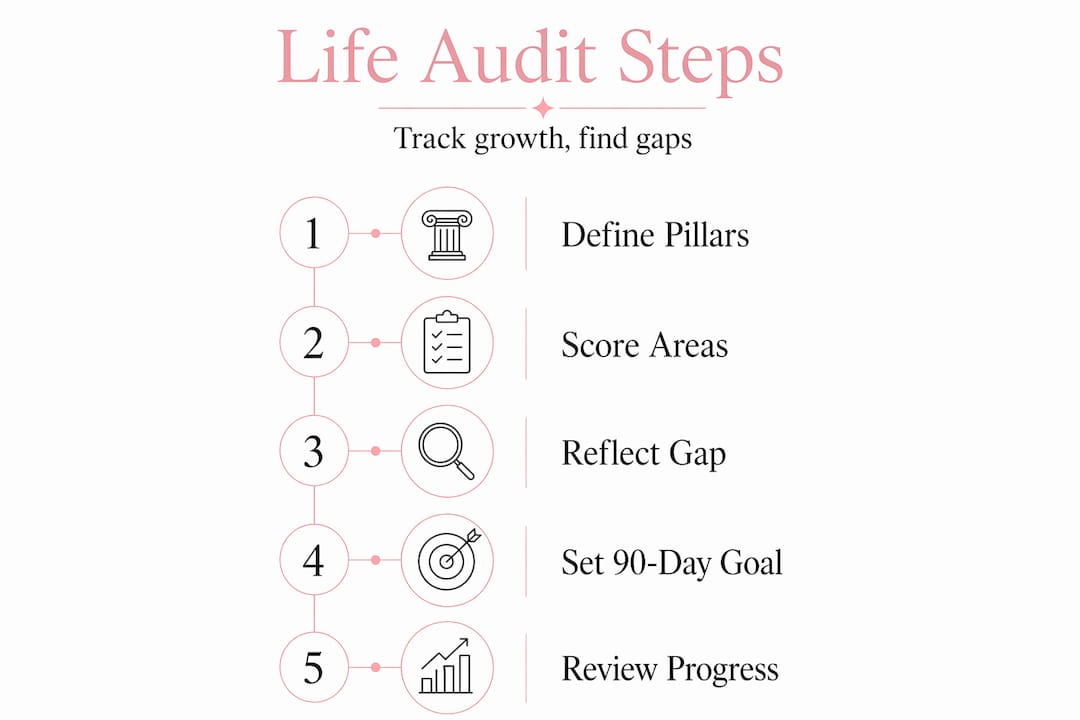
Next, choose your life pillars. These are the main categories you will audit. Common ones include:
- Health and body (physical energy, sleep, movement)
- Career and purpose (work satisfaction, growth, alignment)
- Relationships (intimacy, friendships, family dynamics)
- Finances (stability, debt, goals)
- Personal growth (learning, creativity, spirituality)
- Environment (home, community, digital spaces)
You do not need to audit every area equally. Choose the ones that feel most loaded for you right now. Trying to overhaul everything at once is one of the fastest ways to abandon the process entirely.
Pro Tip: Set aside a dedicated 2-3 hours for your first audit session. Shorter attempts often miss the core patterns you need to see. Treat it like an appointment you cannot cancel.
For tools, a simple spreadsheet works beautifully because it allows you to track scores across time. Notebooks work too, but spreadsheets make your data visual and searchable. Some people prefer journaling apps, but quantitative spreadsheet tracking reveals growth trends in ways that freeform writing alone cannot.
Conducting the audit: rating, reflecting, and finding the gaps
This is the heart of the life audit process. Once you have your pillars defined, it is time to sit down with radical honesty and evaluate where things actually stand.
Here is how to walk through it:
- Rate each life area on a scale of 1 to 10. One means deeply unfulfilling or neglected. Ten means thriving and aligned. Do not aim for accuracy so much as gut-level honesty.
- Write a one-sentence explanation for each score. Why did you give yourself a 4 in relationships? What does a 9 in career actually feel like? The sentence anchors the number to real experience.
- Identify the gap. For each area, ask: “What would a 9 or 10 look like here?” Write that vision out. This gap, between where you are and where you want to be, is your growth opportunity.
- Notice emotional patterns. Where do you feel resistance? Where do you rush through the questions? Those are often the places most worth slowing down for.
- Ask yourself reflection questions. Examples: “What have I been tolerating?” “Where am I living by someone else’s values?” “What have I stopped believing is possible for me?”
Here is a simple comparison to show what a before-and-after gap analysis looks like in practice:
| Life area | Current score | Ideal score | The gap |
|---|---|---|---|
| Health | 4 | 8 | Poor sleep habits, low movement |
| Career | 6 | 9 | Craving more creative work |
| Relationships | 5 | 9 | Feeling disconnected from friends |
| Finances | 3 | 7 | No savings plan or budget |
The most important mindset shift you can make during this phase is moving from self-criticism to curiosity. Shifting to curiosity reduces shame and makes sustainable growth actually possible. You are not grading yourself. You are diagnosing where you are so you can decide where you want to go.
Pro Tip: If you notice self-judgment creeping in while you score, try replacing the word “failing” with “growing.” A 4 is not a failure. It is data. It is the beginning of a new chapter.
Building your 90-day growth plan
Reflection without action is just very organized sadness. The life audit’s real power lives in what you do after the session ends. This is where your self-improvement strategies go from ideas to a living, breathing plan.
Choose one or two priority areas. Not all six. Not all ten. One or two. The areas with the biggest gap between your current score and your ideal state, or the ones that feel most urgent to your peace of mind right now.
For each priority area, build out the following:
- A 90-day goal. Make it specific and measurable. Not “get healthier” but “walk 20 minutes every morning, five days a week, and be in bed by 10:30 PM.”
- Three supporting habits. Small, daily or weekly actions that move you toward the goal without requiring enormous willpower.
- Two milestones. At 30 days and 60 days, what would you expect to see if you were on track? Define them now so you have checkpoints built in.
- A weekly check-in. Just 10 to 15 minutes every Sunday (or whatever day works) to ask: “Am I doing what I said I would do? What is working? What needs adjusting?”
One of the most common traps people fall into is what you might call “self-reflection tourism.” You do the audit, feel inspired, maybe cry a little, and then put the notebook away and change nothing. Self-reflection tourism is real, and it is the reason most audits do not produce lasting change. The 90-day plan is what protects you from it.
Pro Tip: Write your 90-day goal somewhere you will see it every single day. Your phone wallpaper. A sticky note on the bathroom mirror. Visibility is accountability.
Keeping the momentum: systems for tracking personal development
Starting strong is one thing. Coming back to it is another. The goal of tracking personal development is not perfection. It is pattern recognition over time.
Here is a rhythm that works well for most people:
- Weekly mini-check-ins (10-15 minutes). Review your habits, note what worked and what did not, and adjust if something feels off. These quick sessions keep you honest without becoming overwhelming.
- Monthly score updates. Revisit your life pillar scores. Even a half-point shift upward is real growth worth celebrating.
- Quarterly deep dives. Weekly mini-check-ins and quarterly deep dives are the combination that keeps growth on track and helps you realign as life changes.
For tools, a simple spreadsheet remains the most powerful option because you can track scores visually over time. If you prefer something more tactile, a dedicated journal with a consistent structure works beautifully. The format matters less than the consistency.
Accountability also matters more than most people admit. Whether that looks like a trusted friend who checks in with you, a therapist, or even posting your goals in a private online community, external accountability raises follow-through rates dramatically.

Emotions will rise and fall throughout this process. Some weeks you will feel fired up. Others will feel flat. That is not failure. Research confirms that personality matures over time, meaning the very act of recurring audits works in harmony with who you are becoming naturally.
Troubleshooting what gets in the way
Even the most motivated person will hit rough patches. Knowing the most common obstacles ahead of time means you can navigate them without abandoning the whole process.
Here are the most frequent challenges and how to shift through them:
- Overwhelm. If the audit feels too big, narrow your focus. You do not have to assess every life area in one session. Start with two pillars and build from there.
- Perfectionism. There is no perfect score, no ideal format, no right way to do this. Done imperfectly is infinitely more useful than not done at all.
- Inconsistent tracking. Life happens. If you miss a week of check-ins, do not treat it as proof you are not serious. Just start again the next day without a story attached.
- Vague goals. “Be happier” is not a goal. “Spend 30 minutes a day on something creative” is. Specificity is what transforms intention into progress.
- Self-criticism spirals. If you find yourself being harsh during your audit, come back to the curiosity mindset. Life audits diagnose disconnection early, before it becomes burnout or despair. That is the gift they offer, if you receive them gently.
The audit is not a judgment seat. It is a compass. And a compass only helps if you pick it up and use it regularly.
My honest take on why life audits actually change things
I have watched people sit with a life audit worksheet and cry, not because they were failing, but because it was the first time in years anyone, including themselves, had asked them how they were really doing.
What I have learned is that most people do not struggle with motivation. They struggle with direction. And a life audit, done with compassion, gives you that direction without needing to have everything figured out first. You are not building a perfect life. You are paying attention to your life, maybe for the first time in a long time.
The biggest mistake I see is treating the audit as a one-time event, something you do once when things fall apart. The real value comes from returning to it, again and again, as you grow and shift. Because how to evaluate life goals changes as you change. And that is not inconsistency. That is maturity.
What I know for certain is this: curiosity is more powerful than criticism, every single time. When you approach your own life the way a kind and interested friend would, something softens. Something opens. And from that open place, real change becomes possible. Not because you pushed harder, but because you finally stopped fighting yourself.
— Christine Ballard
Ready to go deeper?

If you are ready to move beyond the idea of a life audit and into the actual practice of it, Blogsppot has resources built specifically for people who are rebuilding, recalibrating, and choosing something better for themselves. You do not need a perfectly curated life to begin. You need a place to start and something to return to when things get hard. At Beautiful Detours, you will find journals, reflection prompts, and tools designed to hold you through the process, not just inspire you for a day. Because growth does not happen in a single session. It happens in the quiet returning, over and over again, to the question of who you are becoming.
FAQ
What is a life audit and why does it matter?
A life audit is a structured personal review where you assess key life areas, identify gaps between where you are and where you want to be, and create a plan for growth. It matters because 73% of adults feel life moves too fast to reflect, and a life audit creates the intentional pause that changes that.
How often should you do a life audit?
A full life audit works well quarterly, with weekly mini-check-ins in between. Consistent repetition is what turns the audit from a one-time exercise into a genuine tracking personal development system.
How do you evaluate life goals during an audit?
Rate each life area on a 1-10 scale, then define what a higher score would look like for you specifically. That gap between your current score and your ideal becomes the foundation of your 90-day growth plan.
What is the biggest mistake people make with life audits?
The most common mistake is treating reflection as the finish line. Reflection alone without a follow-through action plan is self-reflection tourism, and it is why most audits do not produce lasting change.
What tools work best for tracking a life audit over time?
Spreadsheets are particularly effective because they allow you to track scores visually over months, revealing trends that journaling apps alone often miss. A dedicated notebook with a consistent structure works equally well if you prefer writing by hand.