
How to align daily life with core values after trauma

There’s a particular kind of exhaustion that comes not from doing too much, but from doing things that don’t feel like you anymore. If you’ve been through trauma, you may have woken up one day and realized that the life you’re living, the choices you’re making, even the way you speak to yourself, feels borrowed from someone else’s story. You are not broken. You are someone who survived, and survival sometimes asks us to set aside our truest selves just to get through the day. This guide is for you, the woman who is ready to come home to herself, one small and steady step at a time.
Table of Contents
- Why trauma disrupts connection to core values
- Getting ready: Ensuring emotional safety before values work
- Clarifying your authentic core values
- Practical daily alignment: Bringing values into everyday life
- Avoiding common pitfalls and verifying alignment
- Why alignment isn’t linear—and what actually works
- Next steps for growth and support
- Frequently asked questions
Key Takeaways
| Point | Details |
|---|---|
| Safety comes first | Emotional and physical safety are the foundation for values work. |
| Values clarify direction | Identifying core values helps guide personal growth after trauma. |
| Daily actions matter | Small, consistent values-based choices build trust and empowerment. |
| Expect setbacks | Alignment with core values is a non-linear process, requiring patience and self-compassion. |
| Support is available | Community resources and expert guidance can further your healing journey. |
Why trauma disrupts connection to core values
Trauma doesn’t just leave emotional scars. It quietly rewires the way you make decisions, the things you prioritize, and the beliefs you hold about what you deserve. When your nervous system is in survival mode, your brain is focused on one thing: getting through. Authentic values, the things that genuinely light you up and guide your choices, get buried under layers of hypervigilance, people-pleasing, and self-protection.
Values clarification after trauma is actually a key process in recovery, particularly in Stage 3, called Reconnection, of Judith Herman’s trauma recovery model. This is the stage where survivors begin to distinguish authentic core values from trauma-induced survival strategies, rebuilding a self-authored life rather than one written by fear.
Here’s the thing: survival strategies are not character flaws. They were smart adaptations. But they can look a lot like values if you’re not paying close attention.
Common survival strategies vs. authentic values:
- Keeping the peace (survival) vs. genuinely valuing harmony and connection
- Overworking to feel worthy (survival) vs. valuing creativity and contribution
- Saying yes to everything (survival) vs. valuing generosity from a full heart
- Shrinking yourself to avoid conflict (survival) vs. valuing humility
- Numbing emotions to cope (survival) vs. valuing peace and stillness
“Emotional safety is the soil in which authentic values can finally take root. Without it, what we call our values are often just our wounds wearing a disguise.”
The work of separating these two things is gentle, patient, and deeply worth it.
Getting ready: Ensuring emotional safety before values work
After understanding the disruption, it’s crucial to establish safety before exploring values.
You cannot do deep values work from a place of overwhelm. This is not a weakness. It is biology. Trauma-informed principles emphasize emotional and physical safety as foundational for values alignment, enabling trust-building and empowerment before advancing to values-driven choices.
Think of it this way: you wouldn’t try to plant a garden in the middle of a storm. You wait for the ground to settle, and then you begin.
Safety practices and their benefits:
| Practice | Benefit |
|---|---|
| Box breathing (4 counts in, hold, out, hold) | Calms the nervous system quickly |
| Grounding (feet on floor, name 5 things you see) | Anchors you in the present moment |
| Eyes-open meditation | Builds tolerance for stillness without dissociation |
| Journaling with a time limit | Creates expression without overwhelm |
| Gentle movement (walking, stretching) | Releases stored tension safely |
Signs you may be ready to begin values work:
- You can sit with mild discomfort without immediately needing to escape it
- You have at least one trusted person or support system in your life
- You are not currently in crisis or acute danger
- You can identify at least one emotion you feel during the day
- You feel some curiosity, even small, about who you are becoming
Pro Tip: Before any values exploration session, spend five minutes practicing self-compassion. Place a hand on your heart, breathe slowly, and remind yourself that this work is not about fixing yourself. You are not broken. You are healing.
“Safety, Stage 1 of Herman’s model, must precede values work. Rushing into identity exploration without a stable foundation can deepen distress rather than relieve it.”
Clarifying your authentic core values
With safety in place, you can now clarify your authentic values.
Acceptance and Commitment Therapy, known as ACT, offers one of the most grounding frameworks for this work. ACT defines values as chosen qualities of action, not feelings or outcomes. Values are not things you achieve. They are directions you move in, consistently and intentionally, even when it’s hard.
This distinction matters deeply for trauma survivors, because so many of us were taught that our worth is tied to outcomes. ACT gently redirects that: you don’t reach a value, you live it, one moment at a time.
Steps for values clarification:
- Start a values journal. Each morning, write freely for ten minutes about a time you felt most like yourself. What were you doing? Who were you with? What mattered in that moment?
- Notice what moves you. Pay attention to what makes you tear up, what makes you feel proud, what makes you angry. Emotions are data points, and they often point directly toward buried values.
- Use a values list as a starting point. Look up a printed values list and circle the words that feel true, not the ones you think should feel true. There’s a difference, and your body usually knows it.
- Check for survival thinking. For each value you identify, ask yourself: “Am I drawn to this because it genuinely matters to me, or because I’m afraid of what happens if I don’t prioritize it?”
- Narrow it down. From your list, choose three to five values that feel most alive and most authentically you right now. These are your anchors.
Pro Tip: A true value should feel like a small spark of recognition, not a sense of pressure or dread. If a word on your list makes you feel anxious or obligated, it may be a “should” rather than a genuine value. Set it aside gently and keep looking.
Practical daily alignment: Bringing values into everyday life
Once values are clear, focus on aligning daily actions with them.
This is where the real transformation begins, not in grand gestures, but in the quiet, consistent choices you make throughout your day. Practical daily alignment steps include small values-based actions like setting boundaries, prioritizing self-care, journaling to uncover patterns, using values as decision filters, and building routines that signal safety to your nervous system.

Two approaches to daily values alignment:
| Approach | Description | Best for |
|---|---|---|
| Routine-based alignment | Scheduled, predictable actions tied to values (e.g., morning journaling, evening reflection) | Women who find safety in structure and consistency |
| Spontaneous alignment | Noticing values opportunities as they arise and responding intentionally in the moment | Women who are further along in recovery and have more nervous system flexibility |
Both approaches are valid. Most women find that starting with routine-based alignment builds the confidence and nervous system safety needed for more spontaneous expression over time.
Steps to align daily life with your core values:
- Choose one value to focus on for the week. Just one. Trying to live all your values at once is overwhelming.
- Identify one small, low-stakes action that expresses that value. If you value connection, it might be texting a friend. If you value creativity, it might be doodling for five minutes.
- Anchor that action to an existing habit. After your morning coffee, before bed, right after lunch. Habit stacking makes new behaviors stick.
- At the end of each day, write one sentence about how you expressed that value. Not a grade, just a notice.
- At the end of the week, reflect on how it felt. Did the action feel authentic? Did it feel forced? Adjust accordingly.
Examples of values-based daily actions:
- Saying no to one request that doesn’t align with your energy or priorities (boundary-setting as a value in action)
- Taking a ten-minute walk outside (honoring a value of health or presence)
- Writing three things you’re grateful for (living a value of appreciation)
- Asking for help instead of struggling alone (honoring a value of connection or vulnerability)
- Choosing rest without guilt (living a value of self-compassion)
Pro Tip: Start with one change. Just one. Gradual integration builds real confidence, and real confidence is what makes values alignment sustainable rather than another thing you feel like you’re failing at.
Avoiding common pitfalls and verifying alignment
After adding values to your routines, it’s important to avoid common mistakes and confirm your progress.
The most common trap in this work is perfectionism. You miss a day of journaling, or you react from fear instead of your values in a hard conversation, and suddenly the whole practice feels ruined. It isn’t. Alignment prioritizes committed action over symptom elimination. You don’t have to feel healed to act from your values. You just have to keep choosing, imperfectly and consistently.
Common pitfalls to watch for:
- Overwhelm: Trying to change everything at once and burning out quickly
- Avoidance: Identifying values intellectually but never taking action because it feels too vulnerable
- Rigidity: Treating your values list as a fixed rulebook instead of a living, evolving compass
- Comparison: Measuring your values against someone else’s and feeling like yours aren’t good enough
- Shame spirals: Using values work as another way to criticize yourself when you fall short
“Alignment is not about becoming a new person. It is about returning, again and again, to the person you already are beneath the survival strategies.”
Quick checklist to verify if your daily life matches your values:
| Question | Yes / Sometimes / Not yet |
|---|---|
| Do my daily routines reflect what matters most to me? | |
| Do I feel a sense of meaning in at least some of my daily choices? | |
| When I make decisions, do I check them against my values? | |
| Am I able to set at least small boundaries that protect my energy? | |
| Do I treat myself with the same compassion I’d offer a friend? |
Use this checklist monthly, not daily. Growth is slow and real, and you deserve to see it clearly.
Why alignment isn’t linear—and what actually works
Here’s what I’ve come to believe, from everything I’ve witnessed and experienced in this healing space: the women who struggle most with values alignment are often the most driven, the most accomplished, the ones who held everything together for everyone else for years.
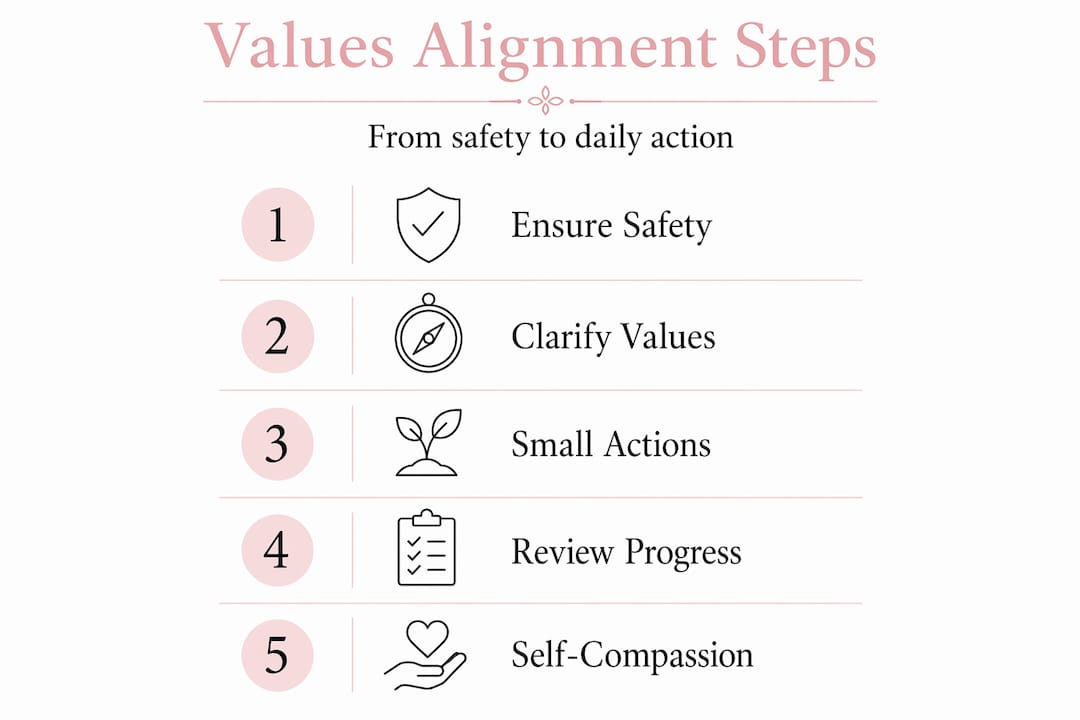
Recovery is a non-linear process, and safety must precede values work to prevent overwhelm. Self-compassion buffers the symptoms that make growth feel impossible. But there’s a layer beneath that which doesn’t get talked about enough.
Many driven women retain their professional values intact after trauma. They still show up for work. They still produce. But their personal values, the preferences, the pleasures, the quiet things that make them feel alive, get completely erased. Recovery after narcissistic abuse or chronic trauma often involves a slow and patient re-sensitizing to internal signals, learning to notice what you actually enjoy, what you actually want, what actually feels good in your body.
This is not a fast process. And it cannot be forced. The women I see make the most sustainable progress are the ones who give themselves permission to not know yet. They stay curious. They treat their healing like a long, winding road rather than a destination they’re already late to.
The other thing I want you to hear: setbacks are not failures. They are information. When you act from fear instead of your values, that moment is telling you something. Maybe the stakes felt too high. Maybe your nervous system wasn’t regulated enough. Maybe that particular value needs more support before it can be expressed safely. None of that means you’re going backward. It means you’re paying attention.
Alignment is a practice, not a performance. And you are allowed to be a work in progress.
Next steps for growth and support
You’ve done something brave just by reading this far. Choosing to reconnect with your values after trauma is one of the most courageous acts of self-authorship there is.

If you’re looking for a place to continue this journey, with stories, tools, and a community that truly gets it, the Beautiful Detours blog is here for you. You’ll find reflections on healing, prompts for values journaling, and resources designed specifically for women rebuilding their lives from the inside out. You don’t have to figure this out alone. There is a whole community of women walking this same winding road, and there is room for you here, exactly as you are right now.
Frequently asked questions
What are core values and why do they matter in trauma recovery?
Core values are deeply held beliefs that guide your choices and actions. Clarifying them is a key part of recovery, particularly in Stage 3 of Judith Herman’s model, where survivors rebuild a self-authored life rather than one shaped by fear or survival.
How can I tell if a behavior is aligned with my true values or just a survival tactic?
Ask yourself whether the motivation comes from authentic belief or from fear of consequences. Survival tactics feel urgent and are focused on avoiding discomfort, while values-based actions feel meaningful, chosen, and grounding even when they’re hard.
Is it normal to feel unsure or scared when trying to act on my values?
Absolutely, and it doesn’t mean you’re doing it wrong. Safety must come first in trauma recovery, and progress looks like small, safe steps taken over time, not a sudden leap into certainty.
What are practical ways to start aligning daily life with my values?
Begin with one small, values-based action each day, like setting a gentle boundary, journaling for ten minutes, or building a routine that signals safety to your nervous system. Small and consistent always beats big and overwhelming.